What Was the Original iPhone?
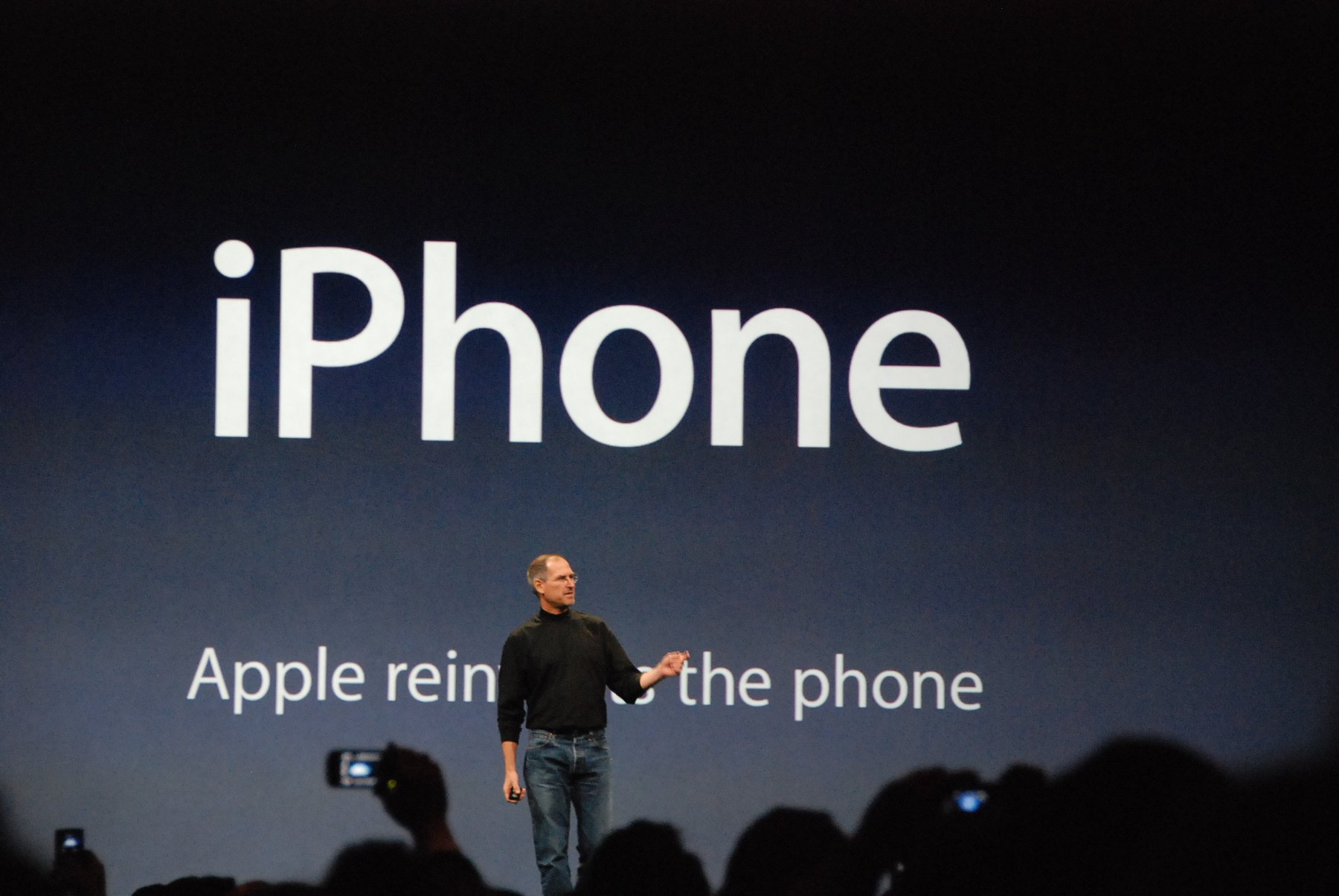
On January 9, 2007, Steve Jobs stood on a Macworld stage in San Francisco and described three products — a widescreen iPod with touch controls, a revolutionary mobile phone, and a breakthrough internet communicator. He repeated that they were not three separate devices. It took the audience the full three repetitions to understand what they were about to see: a slab of glass with one button, and the end of the keyboard era of personal computing.
The kingdom of plastic keys
To rate what happened that day you have to remember what a phone was in 2006. The market belonged to Nokia — roughly one handset in two on Earth — with Motorola's razor-thin RAZR as its pop icon and BlackBerry's thumb-typed keyboard quietly owning corporate America. "Smartphones" meant Palm Treos and Windows Mobile devices whose software assumed you carried a stylus, crashed in colorful ways, and shipped with a carrier's logo glowing on the front. Because carriers bought handsets in bulk for subsidies, carriers ran the industry: they dictated designs, demanded custom skins, preloaded their own stores and ringtones, and treated the internet as a walled garden they metered by the kilobyte. Apple did not join this industry. It walked past it: one hardware design, its own operating system, its own browser rendering the actual web, and — radical for a phone — software Apple alone controlled and updated.
The argument for glass
The iPhone's central idea was that the keyboard was the problem, not the feature. Apple had bought a small multi-touch company called FingerWorks in 2005 and spent two years turning its research into a phone with no moving parts on its face: a 3.5-inch screen at 320 by 480 pixels — sharper than any laptop of the day — governed entirely by fingers that doubled as the keyboard, the dial pad, the shutter, and the scrollbar. Jobs mocked the stylus with the line that sold the concept ("who wants a stylus?") because the real claim was that the input device was already attached to your hands. Everything else followed from the glass: pinch-to-zoom, the rubber-band bounce at the end of a list, the swipe that replaced every switch, the ritual of sliding a lock open with your thumb. The browser was the other headline — a desktop WebKit build squeezing the real web through a 3.5-inch window, in a world where "mobile internet" had meant crippled WAP pages. It shipped with two features Americans loved more than any spec: visual voicemail, and Google Maps you could drag.
Everything it did not have
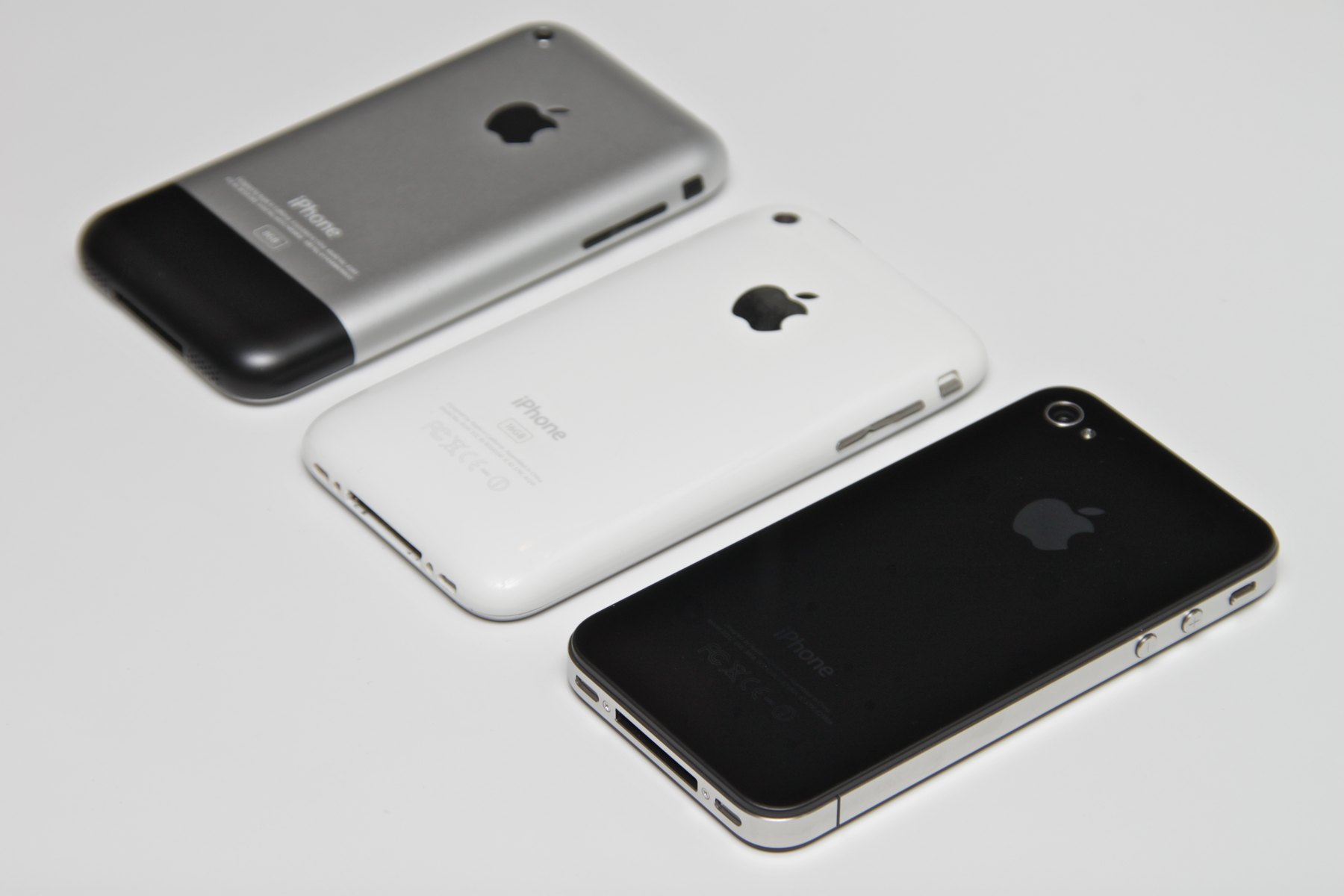
Released June 29, 2007 at $499 for the 4 GB model with a two-year AT&T contract, the original iPhone was a stunning product defined almost as much by its absences. No App Store — you could not install third-party software at all. No copy and paste. No MMS, no video recording, no flash, no GPS chip, no stereo Bluetooth. No 3G: it crept along on EDGE at modem speeds in a world that was starting to roam. No tethering, no folders, no notification center, no front camera. Jobs's answer on apps was "the sweet solution" of web apps, which fooled no developer. And then the part the storybooks leave out: within about three weeks hackers had unlocked the phone, and by early 2008 a pirate scene called jailbreaking was installing cracked apps through back-door installers — proof the box was a real Unix computer in every pocket, and embarrassing enough that Apple folded. It announced a software development kit in October 2007 and opened the App Store on July 10, 2008 with about 500 apps; the store did ten million downloads in its first three days. Copy and paste, the most mocked omission in consumer-electronics history, arrived in the software update that summer. The absences were the strategy: ship a sealed, polished, two-year-behind-the-frontier device that behaved, then let the roadmap make early buyers feel like pioneers.
Who blinked
The business shockwave outran the product. Apple negotiated an exclusive with AT&T on terms that read as arrogance at the time — Apple picked the store placement, the advertising, the price, and kept the subsidy for itself — and the deal inverted an industry where carriers had always owned the customer relationship. Within four years every major carrier was lining up to subsidize whichever phone the public actually asked for, quietly becoming the dumb pipes they had once forced everyone to be. The incumbents' answers explain the collapse by their absence: Nokia, with half the planet's handset revenue, dismissed a battery-hungry glass keyboardless device aimed at teenagers and called it a niche; its smartphone share fell off a cliff within three years, and by 2013 the company that had made the phones the world's default was sold to Microsoft. BlackBerry bet that enterprise email and a physical keyboard were a moat; the enterprise bought iPhones anyway, with keyboards appearing as on-screen options and then not at all. And the price — $499, then $199 after the 3G model arrived in 2008 — was never the point; the original design sold roughly six million units in two years at premium prices, and the company behind it had reinvented a market the size of the entire computer industry before most competitors had a touch-screen prototype shipping.
A data center in every pocket
What the iPhone actually shipped was a sensor package disguised as a phone: a computer with more power than guided Apollo to the Moon, plus an always-on camera, an accelerometer that knew which way was up, Wi-Fi positioning that knew roughly where you stood, and a connection that was never off. Almost every product category that could be absorbed was absorbed in under five years. Compact cameras collapsed from a hundred-odd million units a year to a rounding error, and Kodak — a century old — died of it. Dedicated satellite navigators vanished from windshields. The iPod, the product that had funded all this, was cannibalized on schedule, its sales peaking the year before the App Store. Foursquare, Instagram, Uber — companies that could not have existed without pocket sensors and pocket connectivity — launched within three years of the keynote. And the bill arrived with the convenience: an industry engineered around notifications, feeds, and infinite scroll, because the device was always on and always with you. The phone did not create attention economics; it gave them a delivery vehicle that never left the room.
Why it still matters
The interface of 2026 is the iPhone's interface. Glass-first interaction runs cars, thermostats, televisions, doorbells, and every car dashboard pretending it isn't a phone on wheels. The App Store invented the economic unit of the next twenty years — the platform tax, the two-sided marketplace, the antitrust case — long before anyone argued about an app store in front of a legislature. And the mental model, the one the beige tower never taught and the translucent iMac came closest to, finally landed: the computer is an appliance that lives with you, needs nothing from you, and connects you to everything. Every argument still running — open versus sealed, glass versus keys, convenience versus attention — was scheduled by a 3.5-inch slab that couldn't even copy and paste.
Frequently asked questions
Why didn't the iPhone launch with an App Store?
Apple genuinely feared unvetted third-party code on a phone-grade Unix machine and wanted to keep the platform (and the margin) closed, betting web apps would be enough. Developers and jailbreakers disagreed loudly enough that Apple reversed in nine months — and turned the reversal into the century's best business model.
Wasn't $499 a suicide price?
It was a positioning price. Apple never needed units against Nokia; it needed the phone to read as the premium object in the room, with the $199 3G model of 2008 waiting to open the floodgates. The one-year-old price cut — from $499 to $399, before 3G even existed — produced an apology letter from Jobs and a class action, an early taste of how fast the company would move versus how carefully it treated customers.
Why couldn't Nokia or BlackBerry answer it?
Both were answering with their strengths, which is exactly the trap. Nokia's edge was hardware cheapness and carrier relationships — everything the iPhone made irrelevant; BlackBerry's was enterprise email on a keyboard — a moat that evaporated once email became a push app on glass. Each needed to dismantle its own best business to respond, which is the hardest move in business, and neither tried seriously before the market had moved.
Was the original iPhone a commercial success?
By its own standards, yes — about 1.1 million in its first quarter on sale and roughly six million lifetime, at prices no phone had commanded since the RAZR — but it was the second act that mattered: by 2010 the franchise was selling tens of millions a year and reorganizing Apple's entire fortune around it.
Key terms
- Multi-touch
- Controlling a screen with simultaneous finger gestures — pinch, drag, flick. Apple bought the core technology from FingerWorks in 2005 and made it the product.
- Feature phone
- Pre-iPhone default: a device with fixed keys and locked software, designed by committee with a carrier. The category the iPhone made a synonym for "old."
- EDGE
- The 2.5G data standard the first iPhone shipped on — roughly modem-class speeds, deliberately chosen for battery life while 3G chipsets still ate them.
- Visual voicemail
- The killer feature Americans quote to this day: a list of messages to tap and skip, instead of dialing your own number and listening to tape.
- Jailbreaking
- Removing Apple's software locks to install unauthorized apps. A 2007–08 pirate scene that functioned as a forced product roadmap for the App Store.
- App Store (2008)
- The curated storefront with 70/30 revenue split opened July 10, 2008 with about 500 apps — 10 million downloads in three days, and the economic template for the next two decades.
- Convergence
- The iPhone absorbing camera, navigator, recorder, player, flashlight, wallet, and console. Each dead category is measured in the company that died of it: Kodak, Garmin.
- Dumb pipe
- What carriers feared becoming once Apple owned the customer relationship — and what every carrier became anyway.