What Was the IBM PC 5150?
Introduction
On August 12, 1981, IBM announced a beige machine with a small blue logo and a plain name: the Personal Computer, model 5150. It was not the first personal computer — the TRS-80, Apple II, and Commodore PET had beaten it to homes by four years, and hobbyists had been building their own since the Altair. What the 5150 did instead was something none of those machines achieved: it made “PC” the default word for a computer, and it set the standard every other manufacturer would build to for the next four decades.
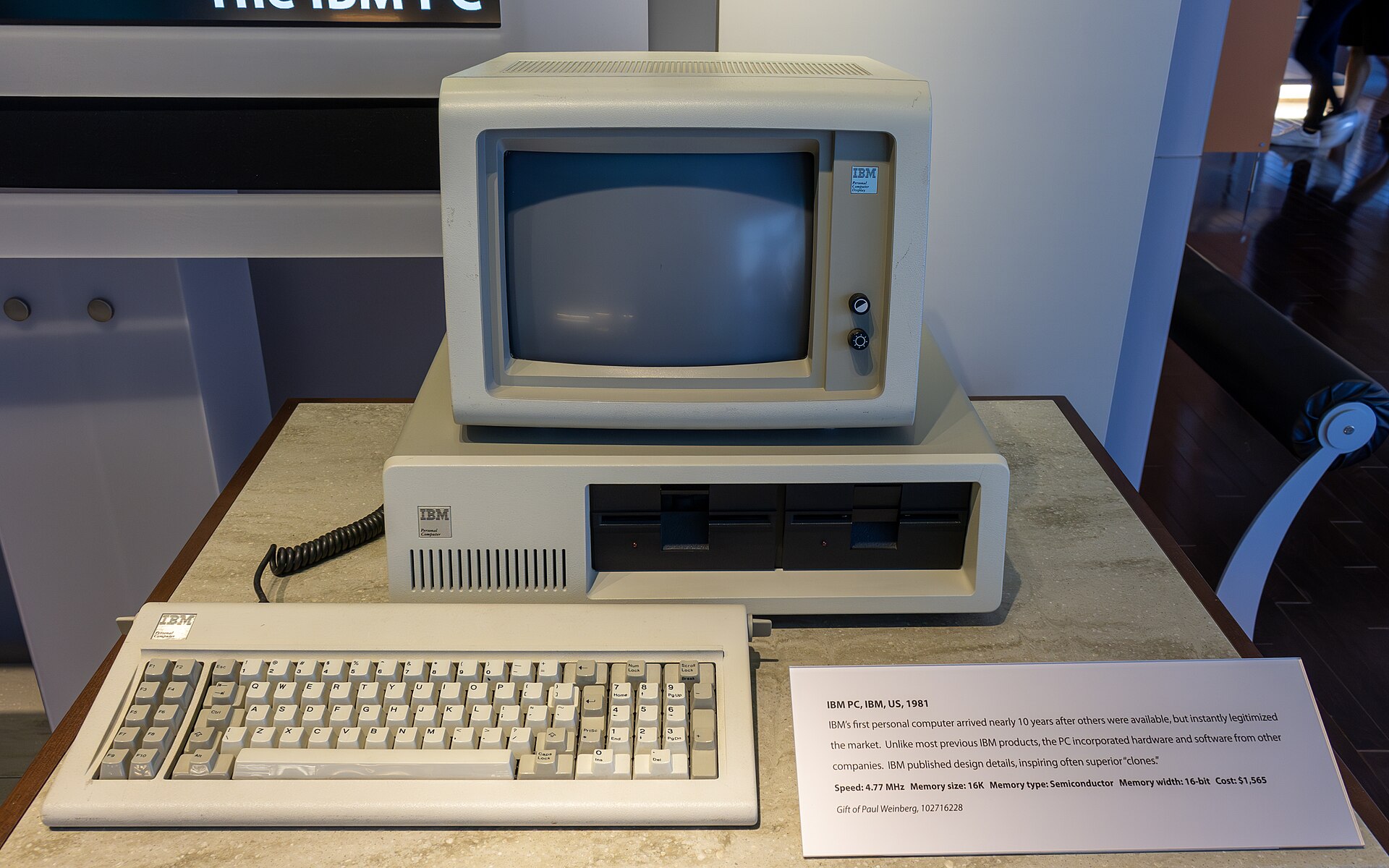
Starting at $1,565 for a 64KB configuration — and a realistic $3,000 or more once you added a monitor and disk drives — the 5150 was expensive by the standards of the day. It sold anyway, because it carried the IBM name into a market that hobby machines had never penetrated: business.
History and Development: Project Chess
IBM’s response to the early-1980s microcomputer boom was unusually fast for the company. A secret team of roughly a dozen engineers, working in Boca Raton, Florida under the code name Project Chess, was given an almost unheard-of mandate: build a personal computer in about a year. The project was led by Don Estridge, later remembered as the “father of the IBM PC.”
The team broke with IBM tradition in almost every way. Instead of designing custom chips, they used off-the-shelf parts — Intel and Motorola components you could buy from any distributor. Instead of a closed appliance, they built the machine around a motherboard with expansion slots and standard buses. And instead of the usual five-year product cycle, the whole machine shipped in roughly twelve months.
The processor choice fell to Intel’s 8088 — the 8086’s sibling with an 8-bit external data bus. It was the cheaper design choice: it could reuse inexpensive 8-bit support chips, and IBM’s familiarity with the 8080 family reduced risk. Software came from outside too: the machine booted into PC DOS from Microsoft, with a 32KB BASIC interpreter living permanently in ROM.
Technical Specifications
The launch 5150 paired a 4.77 MHz Intel 8088 with 16KB to 256KB of RAM, 32KB of ROM BASIC, and 5.25-inch floppy drives storing 160KB per side. Video was either a crisp 80-column monochrome text display (MDA) or the newer color graphics adapter (CGA) — color and text did not coexist in a single mode, a quirk owners learned to live with. Inside the case sat five expansion slots, which is where the machine’s real story lived.
The Open-Architecture Bet
Here is the decision that changed computing: IBM published everything. The IBM Personal Computer Technical Reference shipped with complete board schematics, connector pinouts, and even the BIOS source listing, explicitly inviting third parties to build expansion cards and software without asking permission. IBM’s logic was confident to the point of blindness — surely only IBM could build an IBM.
Two other details turned out to matter more than anyone inside IBM realized at the time. IBM bought DOS as a license, not a purchase — Microsoft kept the right to sell MS-DOS to anyone else. And the published architecture meant competitors could legally study the machine and build their own versions. In 1983, Compaq shipped the first fully legal “IBM PC compatible,” using a clean-room reverse-engineered BIOS, and the floodgates opened.
Impact on Personal Computing
For business buyers, IBM’s name removed the risk: nobody got fired for buying an IBM PC. The machine’s legitimacy attracted the killer applications — Lotus 1-2-3 and dBASE especially — which attracted more buyers, which attracted more software. IBM’s own marketing leaned into the ordinary office: one famous campaign quoted the results of surveying secretaries, another ran Charlie Chaplin imagery from Modern Times.
Because the standard was open, the market that grew around it was enormous — and it did not belong to IBM. Whole companies rose on clones, add-on cards, hard drives, and software built for “IBM PC compatibility.” PC Magazine, founded in late 1981, existed almost entirely to serve this new ecosystem.
Legacy
IBM tried twice to close the door it had opened — first with the ill-fated PCjr in 1984, then with the PS/2’s proprietary Micro Channel bus in 1987 — and both attempts failed against an industry that had grown rich on the open standard. By the late 1980s the acronym “PC” no longer meant IBM; it meant the architecture. In 2005, IBM sold its entire personal computer business to Lenovo.
Every mainstream computer sold today is still a 5150’s descendant: same x86 instruction lineage, the same firmware-to-OS boot idea the ROM BASIC machine pioneered, expansion slots that run all the way from those five ISA sockets to today’s PCIe. The 5150 was not the most clever or the most capable machine of its era. It was the one the whole industry agreed to copy — which in standards, as in history, is the same thing as winning. The interactive computer timeline shows it as station two, between the TRS-80 and the Macintosh, which is exactly where it belongs.
Conclusion
The IBM PC 5150 did not invent the personal computer. It invented the PC — the open, cloned, industry-wide standard that defined what a computer was for a generation and still defines what one is today. IBM won the market so thoroughly that it lost the monopoly, and computing has run on the deal it struck in 1981 ever since.
For more on the machines that built the modern world, or our services at Byte IT, visit our Computers category.
Frequently Asked Questions
Q: What was the IBM PC 5150?
A: IBM’s first personal computer, announced August 12, 1981, built around an Intel 8088 and sold as the machine that established the “PC” industry standard.
Q: Was the IBM 5150 the first personal computer?
A: No. The Altair, Apple II, TRS-80, and PET all preceded it. The 5150 was the machine that made the IBM PC architecture — and the term “PC” — the industry default.
Q: Why did IBM allow clones of the PC?
A: It largely didn’t plan to. IBM published its schematics to grow the add-on market, and Microsoft kept the right to license MS-DOS to others. Once Compaq legally reproduced the BIOS in 1983, the clones were unstoppable; IBM’s later attempts to re-close the design (PCjr, PS/2) failed.
Glossary
- Project Chess: The secret Boca Raton project team that designed the 5150 in about a year, led by Don Estridge.
- ISA bus: The 5150’s expansion bus, named “Industry Standard Architecture” only after IBM’s 1987 Micro Channel made “standard” worth trademarking. IBM’s open slots created the entire add-in card industry.
- Clean-room BIOS: The legal reverse-engineering method that let Compaq build the first true IBM PC compatible without copying IBM’s code.
- PC compatible: The industry’s term for machines built to the 5150 standard — the ancestor of every x86 machine sold today.