What Was the Original Macintosh?
Introduction
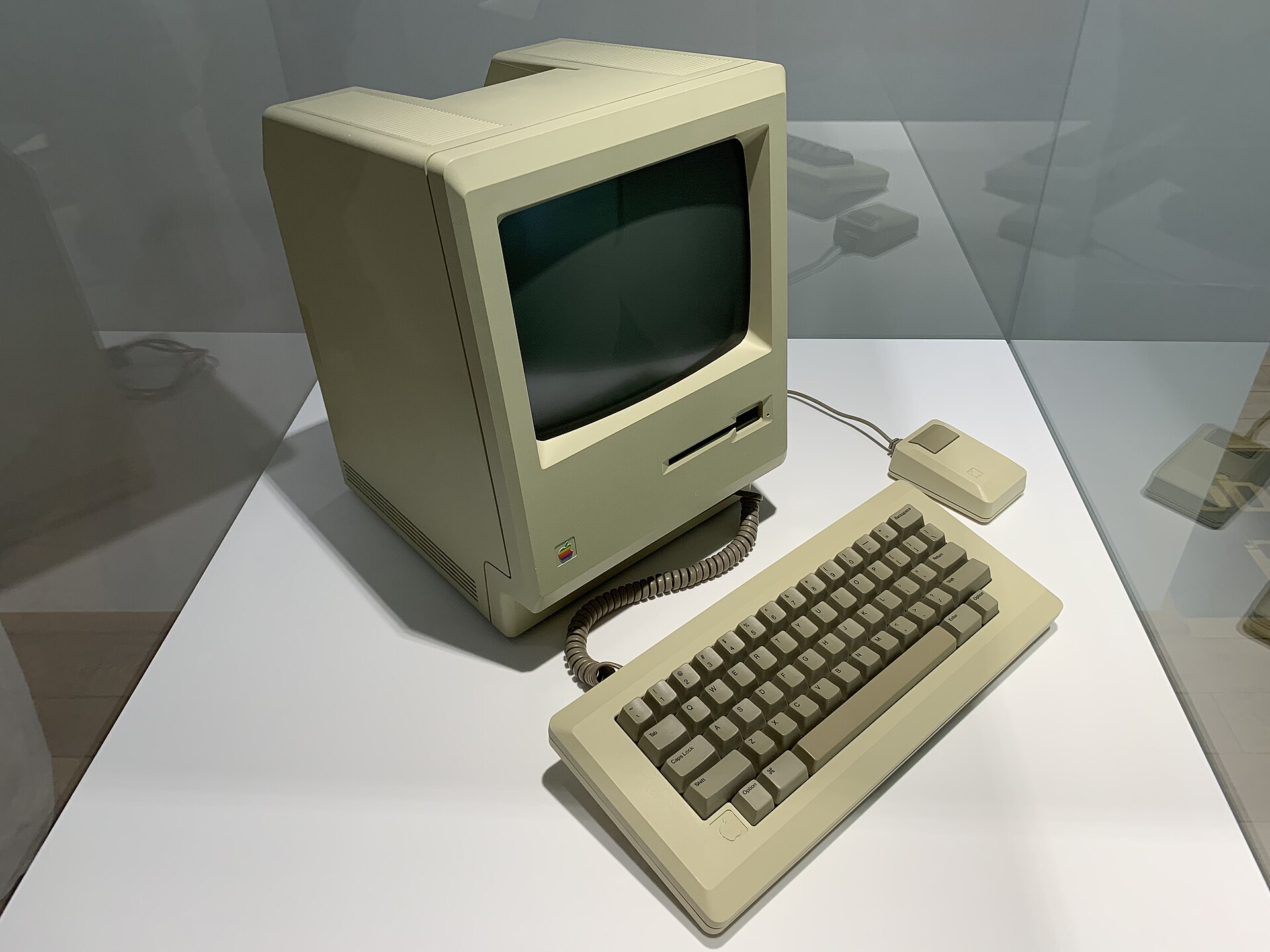
On January 24, 1984, Steve Jobs walked onto a stage in Cupertino, opened a canvas satchel, and pulled out a beige box with a built-in screen — the same machine he had introduced to the world two days earlier in a Super Bowl commercial that told an entire industry it was about to be freed from a big brother who smiled while it ate his food. The Macintosh cost $2,495, carried 128 kilobytes of memory, and had no hard drive, no arrow keys, and no fan. It also carried an idea that turned out to be worth more than all the hardware IBM was selling: that a computer should be pointed at, not typed at. The IBM 5150 had standardized what a computer was. The Macintosh changed what a computer felt like.
History and Development: From Breadboard to Appliance
The Macintosh began in 1979 as a side project by Jef Raskin, an Apple engineer who wanted “an inexpensive, friendly machine for the average person” — a low-cost appliance you’d set on the kitchen table, named after his favorite apple, the McIntosh. Raskin’s team recruited a young electronics whiz named Burrell Smith, who famously built a prototype around the Motorola 68000 — a chip twice as wide as the design called for — by wiring it together out of off-the-shelf parts on a breadboard no bigger than a sandwich. His improvised trick of feeding data to the screen a bit at a time made a high-resolution graphics display affordable in a machine this small.
Then Steve Jobs took the project over. Jobs had been pushed off the Apple II line and exiled to the Mac team, and he remade Raskin’s friendly kitchen appliance into something more ambitious and far more expensive: a sealed, self-booting appliance with a graphical interface borrowed from Xerox PARC and refined on the commercial failure that was the Lisa — a machine that cost $10,000 precisely because it tried to be everything. The Mac was to be the Lisa at a tenth of the price. Jobs drove the team to absurd standards of internal perfection — the circuit board had to look beautiful, because, he insisted, the person who someday opened the case deserved beautiful work — and to a famous, demoralizing deadline. “Real artists ship,” the team’s bumper sticker said. The Macintosh shipped, a year late, on January 24, 1984.
Technical Specifications
By the numbers, the $2,495 Macintosh was not obviously a miracle. It ran a Motorola 68000 at 8 MHz, with 128 KB of RAM soldered directly to the board — no expansion slots at all — and 64 KB of ROM holding the entire operating system. Its screen was a built-in 9-inch monochrome CRT displaying 512×342 pixels, every one of them individually addressable. Storage was a single 3.5-inch floppy drive made by Sony, holding 400 KB — a format Apple would go on to drag into the industry mainstream. There was one port for a keyboard, one for a single-button mouse, and that was roughly it. Every other computer of the era, IBM’s included, assumed the user would wrestle with slots, jumpers, and memory configuration. The Mac assumed the user would not, and removed every opportunity to.
The Graphical Revolution: The Mouse Is the Argument
Everything that mattered about the Macintosh lived on the screen. Before 1984, a personal computer showed you text: a cursor blinking in a column of commands you had to memorize. The Mac showed you a desktop — documents as files on a surface, a trash can you dragged paper into, folders you opened by pointing and clicking. This was the bitmapped display done properly: instead of the machine storing characters and rendering whatever a font ROM said, it stored a map of every pixel on screen, which meant the screen could show anything — a drawn curve, a photographed face, a page that looked like the printed page it would become.
The one-button mouse was the interface’s spine. Point, click, drag: verbs a person could invent without instruction. Two bundled programs — MacWrite and MacPaint — made the argument better than any manual could. MacPaint let a stranger draw on the screen within ninety seconds of unboxing; MacWrite showed a document that looked like itself, italics on screen meaning italics on paper. Competitors took years to catch up and years more to sell: Microsoft Windows arrived in November 1985, ran sluggishly on top of DOS, and was widely mocked. It didn’t matter. The argument had been settled the moment a room full of people watched a mouse move a file across a screen and thought, obviously.
Impact on Personal Computing
The Macintosh’s first year was spectacular — roughly 70,000 machines sold by that August, lines outside dealers — and its second was a cliff: sales collapsed in 1985 as the early-adopter market dried up and owners ran into the machine’s limits. 128 KB was almost no room at all; the sealed case refused more memory; the fanless design ran hot enough that early manuals recommended letting the machine rest between long working sessions. Then the Mac found the market that saved Apple: desktop publishing. When Apple shipped the LaserWriter printer in 1985 and Aldus shipped PageMaker that summer, the Mac — with its bitmapped screen, its mouse, and its WYSIWYG screen-to-page fidelity — became the only machine a magazine, a church newsletter, or a real-estate office needed. The publishing revolution paid Apple’s payroll through the late 1980s.
There was a human toll inside the building, too. The Mac division that humiliated the Apple II line was hemorrhaging money by 1985, and the board fight that followed cost Steve Jobs his job at Apple — the man who had built the machine was forced out of the company three years later. The Mac itself, meanwhile, settled into the product line that has never stopped: the 512K in late 1984, the Plus in 1986 with expansion finally allowed, the SE in 1987, and one continuous family tree all the way to the machines Apple sells today.
Legacy
Open any laptop or phone tonight and you are looking at the world the Macintosh insisted into existence: overlapping windows, a pointer you drag, menus across the top, things you click instead of commands you type. Every graphical system that followed — Windows, macOS, and the touch interfaces that eventually replaced the mouse by keeping the metaphor — is descended from the idea proven on that 9-inch screen. The Mac also proved that a computer could be an appliance rather than a kit: sealed, opinionated, finished, designed as much for the unboxing as for the working. It took Apple two decades and a fortune to get the rest of the industry to agree with its worst habit (locking everything down) and its best one (the machine should explain itself). The 128K machine that started it is in museums now, its floppy drive long silent — and every one of those museum Macs still boots.
Conclusion
The Macintosh 128K was too expensive, too limited, and too strange for most of the computing world in 1984 — and it was right about everything that mattered. It didn’t win the first year, or the decade; it won the argument, which turned out to be the permanent kind of victory. The machine in the shop window was a PC. The machine you are reading this on is a Macintosh’s descendant. The mouse is still the argument, and in 1984, the Mac won it.
Frequently Asked Questions
Q: What was the original Macintosh?
A: Apple’s first Macintosh — announced January 24, 1984, priced at $2,495 — an all-in-one computer with a built-in bitmapped screen, a one-button mouse, and a graphical interface, sold with the pitch that anyone could use it.
Q: Why was the 128K Macintosh considered revolutionary if its hardware was so limited?
A: Because its revolution was software and interface, not silicon. The 68000 with 128 KB would have been unremarkable on its own; driven by bitmapped graphics, menus, and a mouse, it made a computer comprehensible to someone who had never touched one.
Q: Did the original Macintosh sell well?
A: Briefly, yes — around 70,000 units in its first months — then sales collapsed in 1985. The machine found its real footing when the LaserWriter and PageMaker turned it into the desktop-publishing standard later that year.
Glossary
- Bitmapped display: A screen stored as a map of every individual pixel rather than a grid of text characters — the enabling technology behind every graphical interface.
- WIMP: Windows, Icons, Menus, Pointer — the four-part vocabulary of the graphical interface the Macintosh carried into the mainstream.
- 68000: Motorola’s 16/32-bit processor, the Macintosh’s engine and the heart of the classic Mac line through the 1990s.
- MacPaint / MacWrite: The two programs bundled with every early Mac that demonstrated drawing and WYSIWYG writing — the Macintosh’s best salespeople.
- Desktop publishing: The 1985 combination of Mac, LaserWriter, and PageMaker that put professional page layout on a $2,500 computer and paid Apple’s bills through the late 1980s.