What Was the Beige 486 Tower?
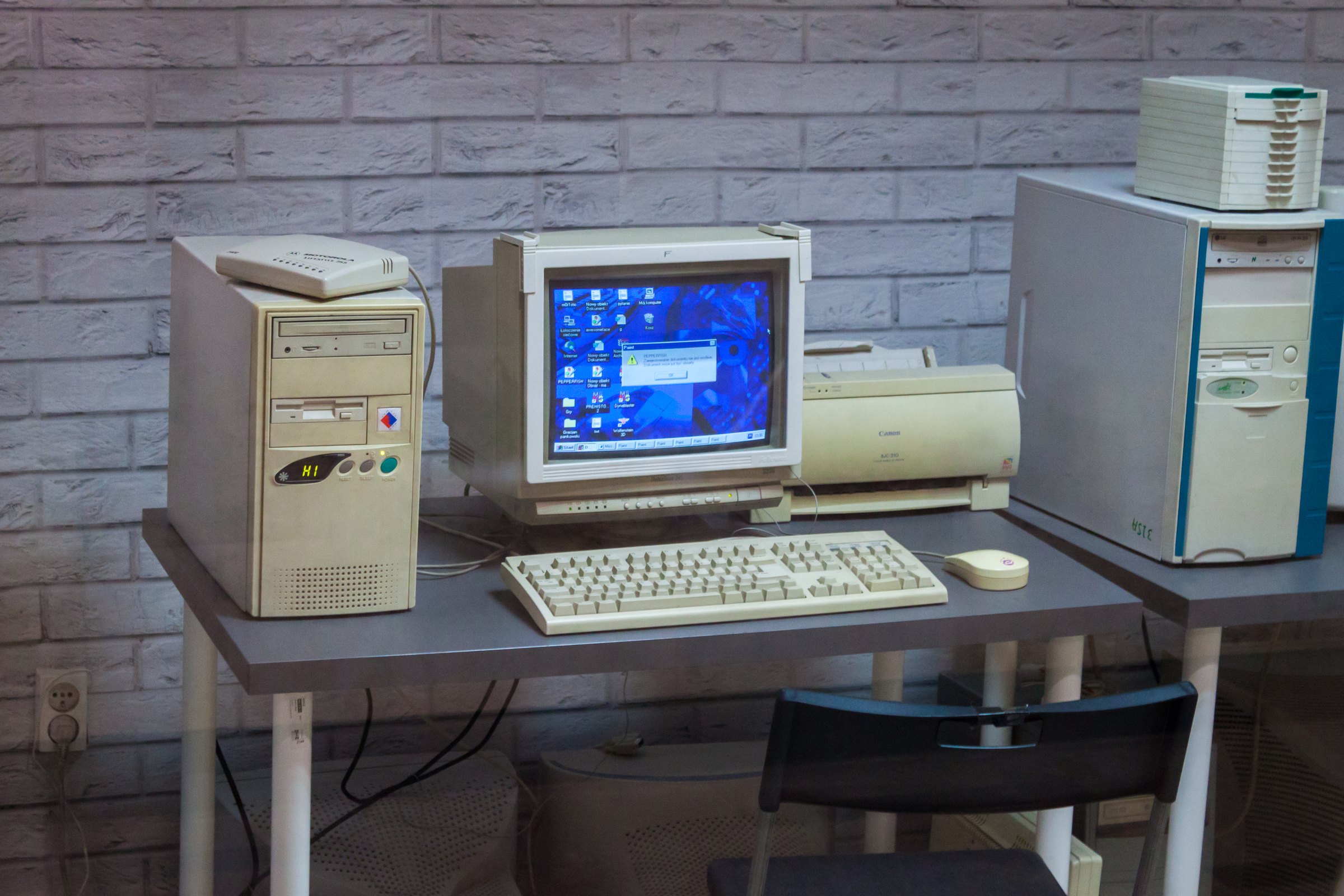
By 1993 the computer had stopped being a machine you kept on a desk and become a machine you kept under it — a beige tower that you bought from a catalog, upgraded yourself, and installed games onto one floppy at a time. It was the first computer millions of families owned outright, the first the kids were allowed to touch, and the one that taught an entire generation that hardware is something you open.
The form the clone wars invented
IBM’s 5150 had arrived as a sensible lunchbox. A decade of clone competition had since shaken personal computing into its permanent shape, and the tower case was the most visible survivor. The logic was pure economics: the clones couldn’t out-brand IBM, so they out-saturated it, standardizing every part into something a factory in Taiwan could make cheaper next quarter. The motherboard followed the AT specification, the drives followed IDE, the slots followed ISA — and because everything followed the same standards, every vendor competed on price, and every buyer learned the words “expandability” and “upgrade path.”
The minitower was the form that won that war at home. Its message was printed on the case itself: this machine is not finished. Drive bays stacked three high, room for a second hard drive you couldn’t afford yet, a power supply rated for the accelerator card you were saving for. The computer had become furniture with a growth plan.
The chip that integrated everything
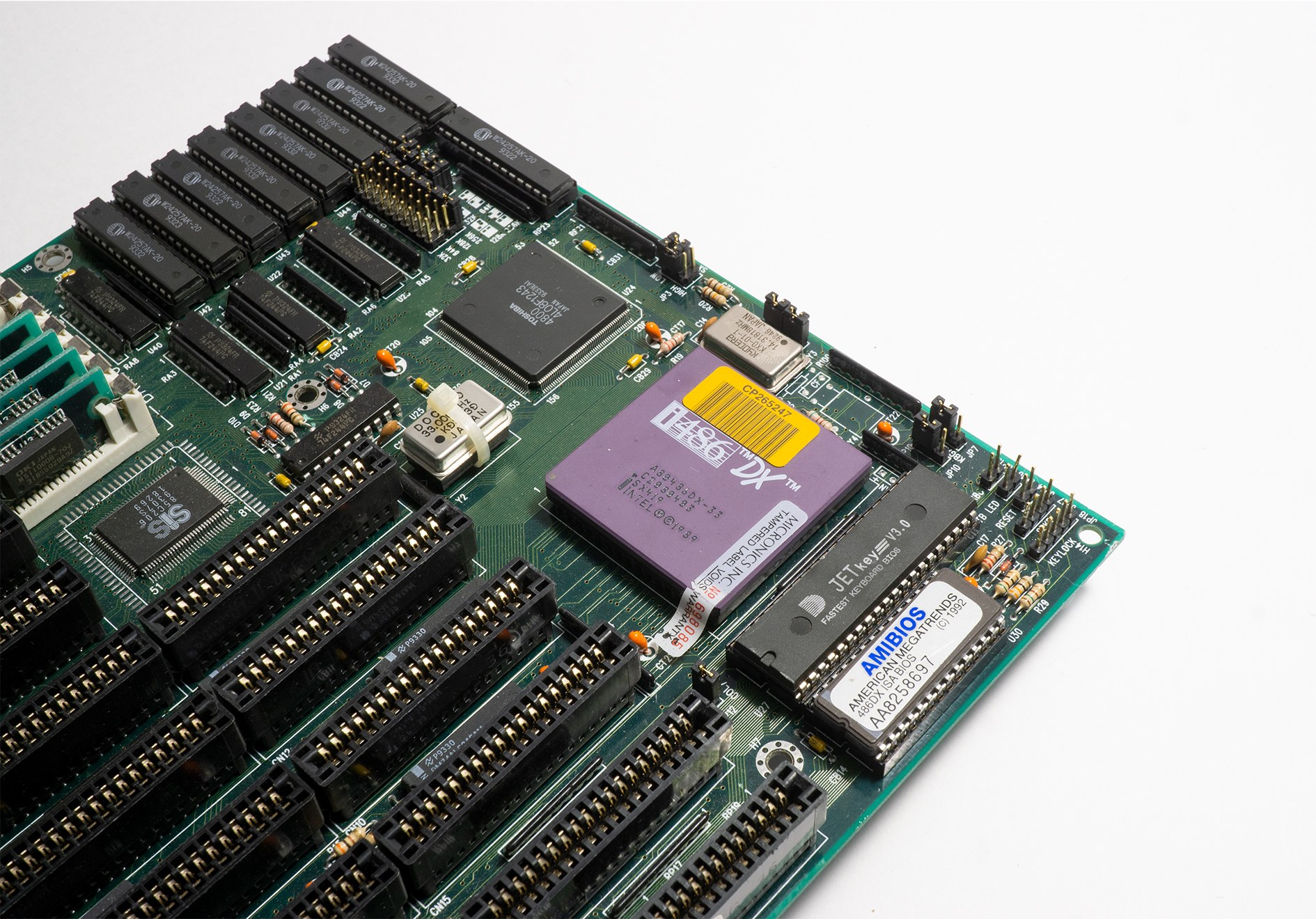
The name on the chip box explains the era better than any advertisement. The 80486, announced in 1989 and the default purchase by 1993, was the first x86 to put a million transistors to work on one die — and instead of spending them on marketing, Intel spent them on integration. The math coprocessor that had been a separate card, sold separately, was now inside. An 8 KB cache lived on the chip itself. The result was a machine that could run spreadsheets and games that needed floating-point numbers — flight simulators, ray tracers, the first texture-mapped worlds — without a $400 add-on.
Then Intel pulled the trick that defined the decade: the clock multiplier. The 486DX2 ran its internal circuits twice as fast as the bus around it — a 33 MHz chip inside a 66 MHz-feeling machine — and the “DX2-66” became the era’s people’s champion, the chip every magazine columnist recommended and every kid memorized. Suffixes became a personality test: SX meant crippled math, DX meant the full chip, DX2 meant doubled, and OverDrive meant the second thoughts you bought a year later and slid into the upgrade socket. Buying a computer in 1993 meant choosing a suffix the way you’d choose a car trim.
The year the case got senses
1993 was also the year the beige box got the organs that made it feel alive. The Sound Blaster and its imitators gave the machine a voice — FM synthesizers for game music, digitized samples for speech, and a CD-ROM drive arriving in “multimedia kits” that magazines insisted you needed. The MPC standard, published that year, was the industry formally admitting that a computer now had to play a movie.
Because CD-ROMs held hundreds of times what a floppy did, content exploded. Encyclopedias learned to talk, adventure games learned to act, and shareware distributors like id Software learned a new business: give away the first episode on a floppy, mail-order the rest, and let the network do the advertising. On December 10, 1993, id released DOOM as a shareware disk — a game so demanding it sold millions of 486 upgrades, and so networkable that offices started installing network cards for it first and doing spreadsheets second.
Life inside the machine
The software was its own discipline. MS-DOS 6.22 loaded the day from CONFIG.SYS and AUTOEXEC.BAT, and every gamer knew the ritual: reboot into a clean CONFIG so the game’s 580 KB of conventional memory would be free. Windows 3.1 sat on top of DOS like a wallpaper of order, its Program Manager a polite suggestion that the computer might be for more than games. The truth was in the GAME directory on drive C, next to the sound-card drivers, next to the batch file that set the joystick and quit Windows and prayed to the memory managers.
And when the machine wasn’t enough — that was the point of a tower. You powered down, touched the case to drain yourself, unsnapped the side, and lay it on its side on the carpet: jumpers to set the clock, SIMMs to add memory, a video card from an anti-static bag, the DX2 pulled from its socket and seated new-direction-first because it had a corner notch that forgave nothing. DOS would find the new drive; you would run SCANDISK and DEFRAG that night like a ritual. A teenager with a screwdriver and a catalog price list was a system integrator.
The price of the era
The catalog math still tells the story: a DX2-66 tower with a 256 MB drive, 4 MB of RAM, a CD-ROM, a Sound Blaster, and a 14-inch CRT ran about $2,000 to $2,500 — roughly $4,500 today, and worth every dollar, which is why the catalogs thrived. IBM’s own machines cost twice as much for the same parts, and everyone knew it. The company that had defined the personal computer was now the overpriced option on the page.
Why it still matters
Three things never left. The tower itself is still the shape of every gaming PC, still sold on upgrade path, still opened by customers with screwdrivers. The upgrade culture the DX2-66 created — buy for today, plan for the socket — is why GPUs still have a enthusiasts’ tier named after frame rates. And the game-as-hardware-engine economy began there: every generation since has been sold the way DOOM sold the 486, by making the old machine feel slow.
The beige tower was the first computer that belonged to the household instead of the office — and the first that the household could take apart. If you ever sat cross-legged on carpet with a case cover on your knee, you were not just using a computer. You were running the era that taught everyone else how.
Frequently asked questions
Why are 1990s computers beige?
Because office equipment was beige, and beige plastic hid the yellowing, scuffs, and cigarette ash of a decade. The industry later standardized on darker grays, but “beige box” stayed the word for the era.
What does DX2-66 mean?
DX meant the full 486 — built-in math coprocessor. The 2 meant the clock doubler: it ran its core at twice the 33 MHz bus, for 66 effective megahertz. It was the most recommended chip of 1993.
Was a 486 really enough for games?
It was the era’s definition of enough. Wing Commander, Ultima Underworld, DOOM, and Civilization all ran on it — DOOM deliberately, because its programmers assumed most players had exactly these machines.
Why did the CD-ROM matter so much?
A 486-era floppy held 1.44 MB; a CD held 550. Voice acting, recorded music, video clips, and scanned maps all became possible on a single disk, which is why 1993 was called the multimedia year.
Key terms
- Tower / minitower
- A case that stands vertically with stacked drive bays; the form that won the home market because it invited upgrades.
- 486 / DX / DX2 / OverDrive
- Intel’s first million-transistor x86, with math unit and cache on-die; DX2 doubled the clock internally, and OverDrive chips let owners upgrade the socketed CPU later.
- Motherboard & socket
- The main circuit board; the CPU socket and its jumpers were how a 1993 owner changed the machine’s speed themselves.
- ISA / VLB / PCI
- The three expansion-bus generations that overlapped in 1993: the aging IBM standard, the fast video-only hack, and the clean successor still in your machine’s DNA.
- IDE
- The standard that let any brand hard drive and CD-ROM plug into any clone — the reason drives became a catalog purchase.
- SIMM
- The stick of memory you added yourself, in matched pairs, by snapping it into the board at an angle.
- Sound Blaster
- Creative’s sound card; the de facto standard games targeted, the same way today’s games target Windows.
- Conventional memory
- The first 640 KB of RAM that DOS programs could touch — the scarce resource the CONFIG.SYS ritual fought over.
- Shareware
- The try-before-you-buy model — first episode free, rest by mail or network — that made DOOM and built the game industry’s economy.