
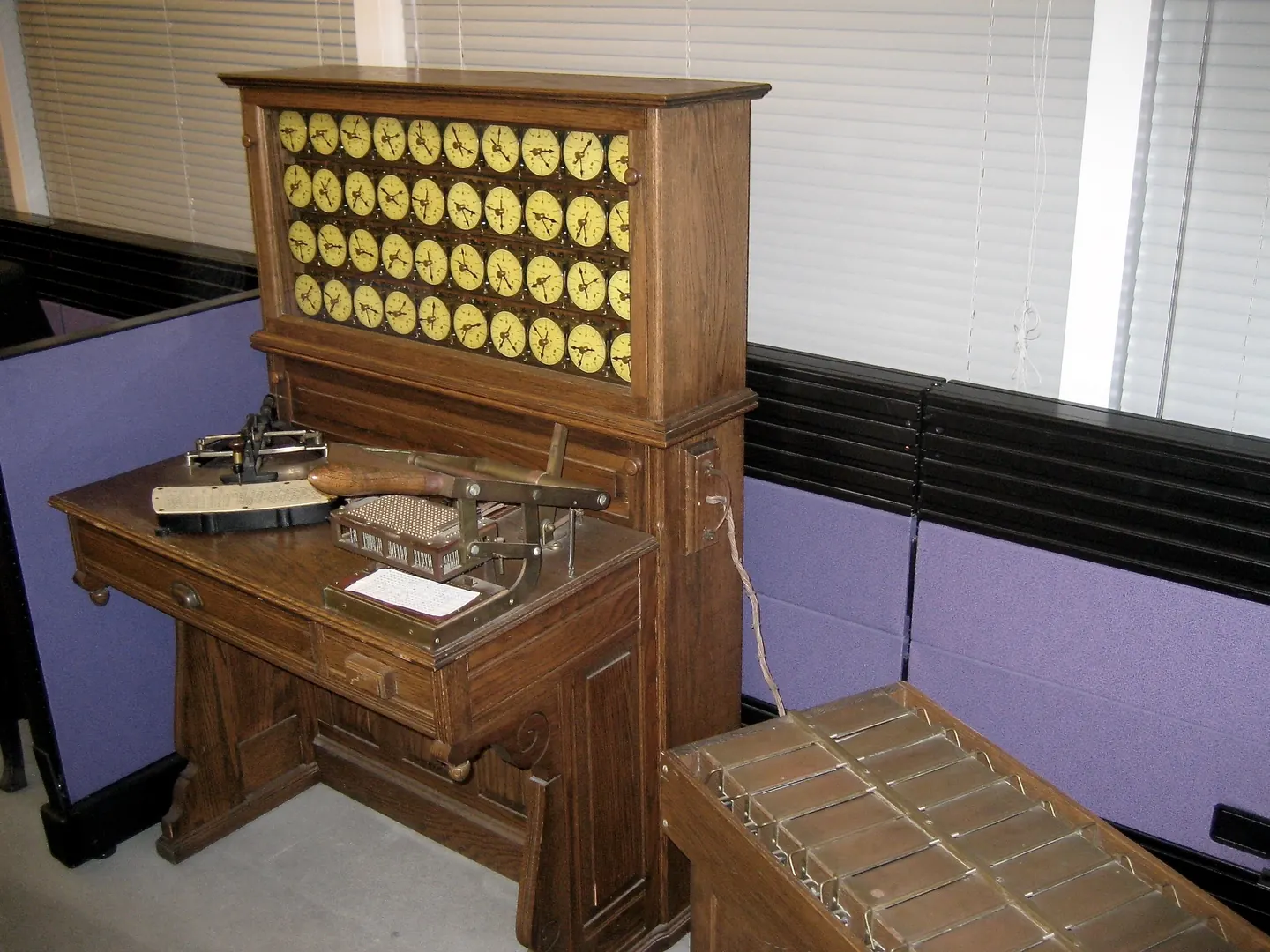
The wooden machine at the start of our Time Corridor is not an early PC. It is an interpretation of Herman Hollerith’s census tabulating system: a desk with a card press, a wall of forty counting dials, and a separate sorting box.[1] A Computer History Museum catalog record documents the period tabulator and sorter arrangement.[2]
The problem was counting, not calculating
By the late nineteenth century, the U.S. census generated far more paper than clerks could comfortably tally by hand.[1] The 1880 census took more than eight years to complete; the Census Office needed a better way to process the 1890 returns.[1] Hollerith, who had worked on census statistics, developed an electrical system for turning marks on cards into counts.[1]
He did not invent punched cards.[1] Earlier machines, including Jacquard’s looms, had used holes in cards to control a physical process.[1] Hollerith’s contribution was applying a punched-card method to data processing: recording facts about people, counting selected categories, and sorting the cards for another pass.[1]
A card was a record, not a program
Census workers first copied information from the original paper schedules onto cards.[1] They used a hand-operated punch or pantograph to put holes in positions representing recorded answers.[1] That preparation still required people and time; the machine did not somehow read handwriting or punch cards for them.[1]
The location of a hole mattered.[1] It represented an answer under the census’s coding scheme; the absence of a hole meant that particular position was not selected.[1] You could then handle a deck of cards as a collection of records instead of repeatedly searching through handwritten schedules.[1]
What happened when the operator pressed the reader
The operator placed a card in the circuit-closing press and brought its top down.[1] Spring-loaded metal pins met the card.[1]
Where there was no hole, the paper stopped a pin.[1] Where a hole let a pin pass through, it reached a mercury contact and completed an electrical circuit.[1] That pulse advanced the corresponding counter on the tabulator’s array of forty clock-like dials.[1]
This is why our 1890 exhibit has dials rather than a screen: the results were mechanical counts, read and recorded by operators.[1] The system did not have a CPU, stored software, or a modern database. A closed or open circuit is a useful ancestor of later digital ideas, but the 1890 machine was a purpose-built electromechanical tabulator, not a programmable computer.[1]
A separate sorter let workers group cards for further analysis.[1][2] The selected card pattern caused a compartment lid to open; an operator then placed the card in that bin.[1]
IBM’s historical account describes a later sorter with as many as 24 categories.[1] Sorting was still physical work, just directed by the coded card.[1]
What changed—and what did not
The advantage was repeatability: a press could increment multiple relevant counters without a clerk adding each tally by hand.[1] IBM’s history says the 1890 population count was completed in six months and more detailed tabulations in two years, versus more than eight years for the 1880 census.[1] Those are different stages of census work, not a claim that every 1890 result appeared in six months.[1]
The labor did not vanish. Someone collected the answers, punched the cards, fed the press, sorted the deck, and wrote down the dial readings.[1] What changed was where the repetitive counting happened: in an electrical circuit and a set of counters rather than entirely in a clerk’s arithmetic.[1]
Hollerith founded the Tabulating Machine Company in 1896.[1] It became part of the Computing-Tabulating-Recording Company in 1911, which took the name International Business Machines in 1924.[1] Punched-card methods went on to serve business accounting and other kinds of data handling for decades.[1]
The point of the exhibit is not that the 1890 census already had a computer like the one on your desk. It is that people had learned to encode information in a form a machine could test, count, and sort. The cards made the data tangible; the tabulator made a large body of records manageable.[1][2]
Explore the 1890 exhibit in the Time Corridor, then continue forward to the IBM PC 5150 to see how different the idea of a “computer” became.
Quick questions
Was Hollerith’s machine a computer? Not in the modern stored-program sense. It was an electromechanical system built to punch, read, count, and sort coded census cards.[1]
Did the cards store instructions? In this application they recorded census answers. The positions of the holes supplied data for the reader and sorter; they were not an executable program.[1]
Why are there forty dials? The tabulator had forty counters so an operator could tally multiple coded categories. Its face looked more like an instrument panel than a later computer display.[1]
