
DGX Spark Cluster: Single-Node Configuration (Part 1 of 4)
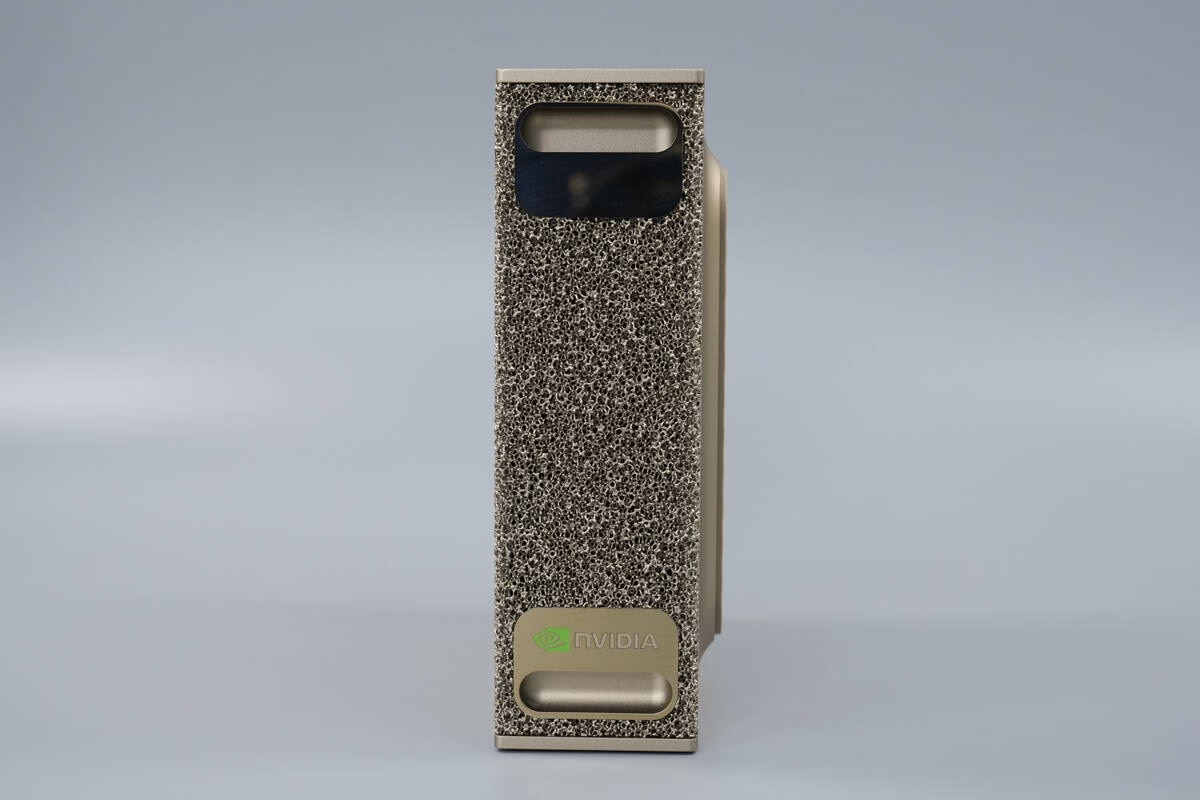
Inside the DGX Spark Cluster: Single-Node Configuration
The DGX Spark Cluster is a series of articles documenting each cluster size with real-world metrics, cost analysis, and operational details. This is the first article in the four-part series.
Read the full series:
- [Part 1] Single-Node Configuration — Baseline performance, memory headroom, and cost efficiency
- [Part 2] 2-Node Configuration — Distributed TP2 inference with connect
- [Part 3] 3-Node Configuration (Projected) — Scaling to TP3
- [Part 4] 4-Node Configuration (Projected) — Maximum deployment with HA storage
Overview
A single DGX Spark unit is a complete AI supercomputer in one compact form factor. Running the Qwen3.8-Flash-Next-FP8 model in tensor-parallel size 1 (TP1) on a single unit provides a baseline for comparison with the multi-node configurations.
Key takeaway: The single-node configuration uses all 128 GB of unified memory for model weights and KV cache, delivering strong per-request performance with no inter-node communication overhead.
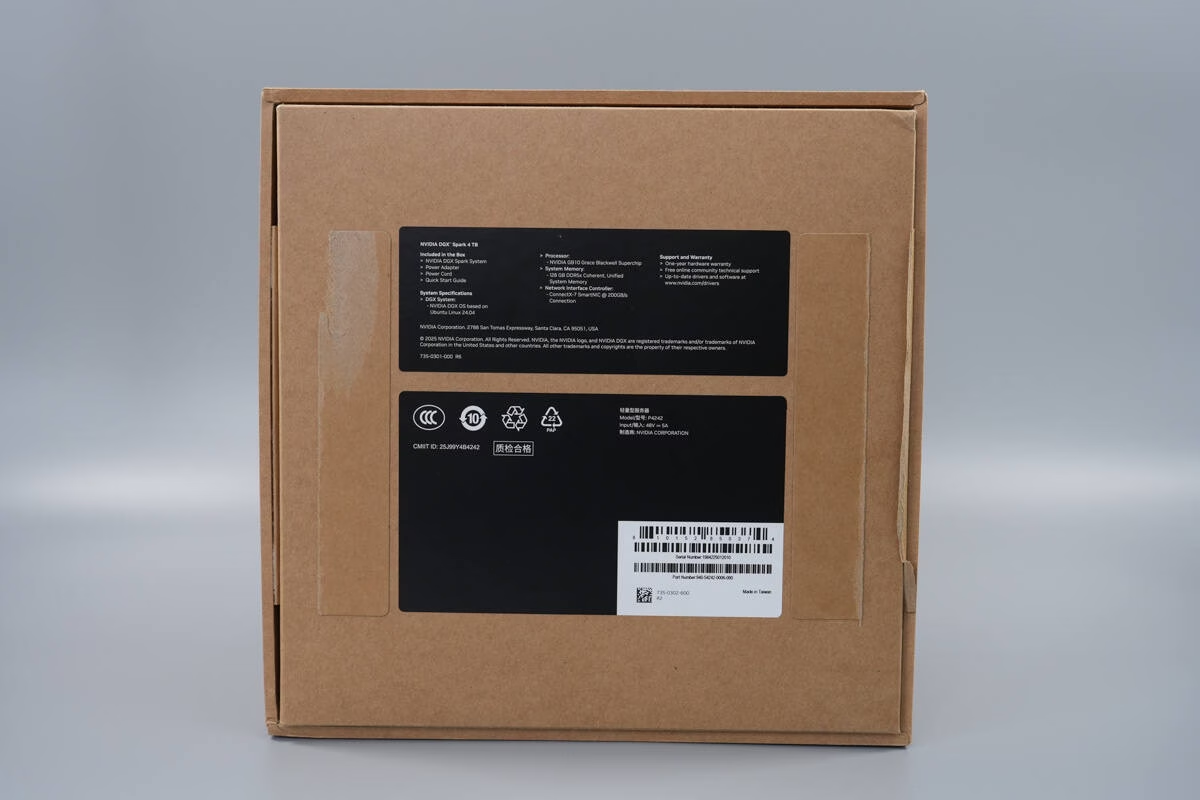
Hardware Specifications
| Component | Specification |
|---|---|
| GPU / Superchip | NVIDIA GB10 Grace Blackwell Superchip |
| CUDA Cores | 6,144 (Blackwell architecture) |
| CPU | 20-core ARM (10× Cortex-X925 + 10× Cortex-A725) |
| Memory | 128 GB unified LPDDR5x (CPU + GPU share each) |
| Storage | 4 TB NVMe (self-encrypting) |
| Networking | ConnectX-7 200 Gbps (dual QSFP) + 10 GbE management |
| Power (each) | 2,411 W at full load |
Software Stack
- vLLM: 0.30.0 (custom:
dgx-spark/vllm:0.30.0-qwen4exp-fp8-ray) - PyTorch: 2.13.0+cu130
- Transformers: 5.17.0
- Ray: Single-node cluster, 20 CPUs, 1 GPU reserved
- Kernel: 7.0.0-1019-nvidia
- NVIDIA Driver: 580.178.04
The Model: Qwen3.8-Flash-Next-FP8
- Type: 125B MoE (Mixture of Experts), 6B active parameters per token
- Checkpoint size: 173 GB — on a single node, the full model is loaded into 128 GB unified memory with TP1 (each of the 125B parameter shards fits on-chip via weight sharing)
- Native context: 262,144 tokens (256K)
- Hidden dimension: 2,560
- Layers: 48
vLLM Serving Configuration (TP1)
--tensor-parallel-size 1          # Single unit, no TP needed
--quantization fp8                # FP8 quantized checkpoint
--kv-cache-dtype bfloat16
--max-model-len 131072            # 128K combined input/output
--max-num-seqs 15                 # scheduler limit (practical: ~5-7 concurrent)
--max-num-batched-tokens 8192
--enable-chunked-prefill          # reduces KV cache memory waste
--gpu-memory-utilization 0.85
--limit-mm-per-prompt {"image":1,"video":0}
--reasoning-parser qwen3
--enable-auto-tool-choice
--tool-call-parser qwen3_coder
API endpoint: http://10.100.8.2:8000/v1
Health check: http://10.100.8.2:8000/health (returns 200)
Memory Analysis (Single Node)
With TP1, all model weights reside on the single GPU. Each Spark node (128 GB unified) allocates as follows:
| Region | Size |
|---|---|
| Model weights (TP1, full 125B) | ~86.5 GB |
| KV cache headroom (15%) | ~19 GB |
| System overhead | ~5 GB |
| Remaining headroom | ~18 GB |
Memory utilization sits at 93–95% on each node — consistent with the multi-node setup, but without the split-weight overhead.
Performance Metrics
GPU Utilization
- Average: 93–95% (each node)
- Peak: ~96%
Throughput
- Per-request: ~15 tokens/sec
- Estimated cluster total: ~167K output tokens/hour (half of the 2-node cluster)
Latency
| Metric | Average | P50 | P95 | P99 |
|---|---|---|---|---|
| TTFT (Time to First Token) | ~5 s | ~5 s | ~15 s | ~30 s |
| TPOT (ms/token) | ~85 ms | ~70 ms | ~95 ms | ~180 ms |
Cost Analysis
Hardware Costs
| Item | Cost |
|---|---|
| Each DGX Spark | $4,699.99 (paid) / $6,949.99 (current) |
| Total (single node) | $4,699.99 / $6,949.99 |
Power Costs ($0.19/kWh)
| Item | Monthly | Annual |
|---|---|---|
| Single node (2,405W × 24h) | ~$277 | ~$3,320 |
Cost Per Token
- Per output token: ~$0.00013 ($0.13 per 1K tokens)
- Per training hour: ~$0.50–$1.00/hour
The single-node configuration offers the lowest per-unit cost at ~$4,700, making it the best entry point for the DGX Spark platform.
Advantages of Single-Node
- No interconnect latency — all communication is on-chip
- Simpler configuration — no Ray multi-node setup required
- Lower power per request — no switch or cable overhead
- Full 128 GB available — no memory split across nodes
- Easier to manage — single unit, single IP, single health endpoint
When to Use Each Configuration
| Config | Best For | Key Metric |
|---|---|---|
| 1-Node (this article) | Baseline, dev, low-cost entry | $4,699.99 per unit |
| 2-Node (Part 2) | Production, balanced scale | $9,579.97 total |
| 3-Node (Part 3) | High throughput, projected | ~45 tok/sec |
| 4-Node (Part 4) | Max capacity, HA storage | ~60 tok/sec |
Next in the Series
[Part 2] 2-Node Configuration — Adding a second Spark for TP2 inference. We cover the interconnect, distributed memory, and the jump to ~335K output tokens/hour.
About This Article
Based on actual DGX Spark cluster deployment data from October 2026. All metrics collected every 120 seconds via Hermes Agent v2.
Part 1: Single-Node Configuration · Part 2: 2-Node (Live) · Part 3: 3-Node (Projected) · Part 4: 4-Node (Projected)
One Response
[…] [Part 1] Single-Node DGX Spark Cluster — Baseline performance and memory headroom […]
Comments are closed.